
Physician-guided support for recovery, repair, and inflammation control.
TransformRX offers personalized peptide protocols designed to support soft-tissue healing, joint and muscle recovery, gut and skin inflammation, immune regulation, and cellular resilience. Depending on clinical appropriateness, a plan may include BPC-157, TB-500/TB-4, Wolverine Blend, MOTS-C, GHK-Cu, KPV, or Thymosin Alpha-1.
Schedule a Consultation
Inflammation can affect recovery throughout the body.
Inflammation is part of the body's normal response to injury and stress, but when it becomes persistent or poorly regulated it may contribute to pain, stiffness, delayed recovery, gut irritation, skin symptoms, and reduced physical performance. A thoughtful evaluation helps determine whether peptide therapy is appropriate and which pathway should be targeted.
Soft-Tissue Recovery
BPC-157 and TB-500/TB-4 are associated with tendon, ligament, muscle, and wound-recovery support.
Inflammatory Signaling
KPV, GHK-Cu, and Thymosin Alpha-1 may be considered in protocols focused on inflammatory and immune regulation.
Cellular Resilience
MOTS-C is studied for mitochondrial energy metabolism, insulin sensitivity, and stress adaptation.
Care designed around your recovery goals.
Depending on your evaluation, a personalized protocol may focus on one or more of the following:
Tendon & Ligament Recovery
Support for slow-healing connective tissues and injury recovery.
Muscle & Joint Recovery
Support for mobility, flexibility, soreness, and return to activity.
Gut Barrier Support
BPC-157 and KPV are used in protocols focused on gut-lining support.
Skin & Wound Repair
Support for tissue remodeling, collagen, and skin-barrier recovery.
Immune Modulation
Support for balanced immune signaling and T-cell function.
Metabolic Resilience
Support for mitochondrial function, energy metabolism, and stress adaptation.
Different therapies support different stages of repair.
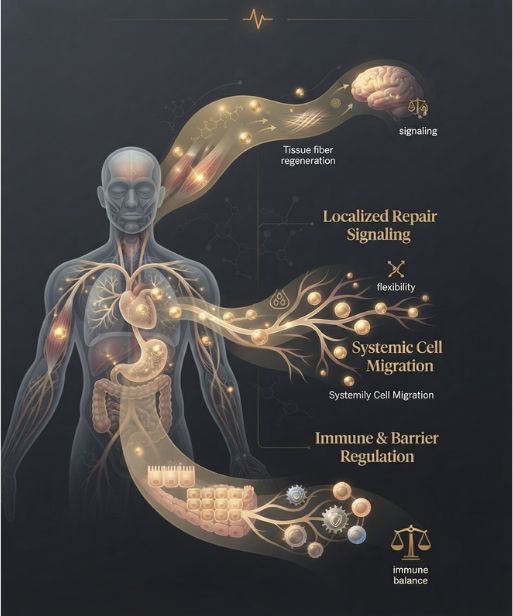
Inflammation-focused therapies do not all work the same way. Some are associated with local tissue repair, others with systemic cell migration, immune modulation, collagen remodeling, gut and skin barrier support, or mitochondrial resilience.
Localized Repair Signaling
BPC-157 is associated with angiogenesis, collagen synthesis, growth-factor signaling, and repair of tendons, ligaments, muscles, and the gastric lining.
Systemic Cell Migration
TB-500/TB-4 supports cell migration, flexibility, angiogenesis, and tissue remodeling throughout the body.
Immune & Barrier Regulation
KPV and Thymosin Alpha-1 are used in protocols focused on inflammatory signaling, immune balance, and barrier support.
Explore the therapies in this support category.
These therapies are not interchangeable. Their evidence, administration, regulatory status, and suitability vary. A TransformRX clinician determines which option, if any, is appropriate.
BPC-157
BPC-157 is a gastric-derived peptide associated with tissue repair and anti-inflammatory signaling. It is used in recovery protocols for soft-tissue healing, gut support, pain modulation, and tendon- or ligament-related concerns.
TB-500 / TB-4
TB-500 is a synthetic fragment related to Thymosin Beta-4. It is involved in tissue remodeling and is used in protocols focused on wound healing, angiogenesis, tendon recovery, and systemic musculoskeletal support.
Wolverine Blend
The Wolverine Blend typically combines BPC-157 with TB-500 or TB-4. The pairing is designed to combine more localized growth-factor and collagen signaling with broader systemic cell migration and tissue-remodeling support.
MOTS-C
MOTS-C is a mitochondrial-derived peptide being studied for its potential to support metabolic function, cellular energy production, insulin sensitivity, and stress adaptation.
GHK-Cu
GHK-Cu is a naturally occurring copper-binding tripeptide involved in wound healing, tissue regeneration, collagen production, skin remodeling, and inflammatory control.
KPV
KPV is an alpha-MSH fragment with anti-inflammatory properties. It is used in protocols focused on gut and skin inflammation, overactive immune signaling, and barrier-tissue support.
Thymosin Alpha-1
Thymosin Alpha-1 is an immune-modulating thymic peptide associated with immune support and T-cell regulation. It is used in protocols focused on immune dysfunction and infection-related support.
What patients may notice over time.
The following timeline is based on the TransformRX BPC-157/TB-500 patient guide. Individual responses vary.
1–7 Days
Early inflammatory signaling may begin to shift, and some patients report less acute soreness or discomfort.
7–21 Days
During the proliferation phase, collagen and fibroblast activity may support improved mobility, flexibility, and reduced stiffness.
3–8 Weeks
Tissue remodeling may support stronger repaired structures, less scar-tissue formation, and a more complete return to activity.
Matching the option to the recovery goal.
This comparison is educational only. Final selection depends on your medical history, symptoms, contraindications, and clinician assessment.
| Goal | Therapies Commonly Considered | Primary Area of Support |
|---|---|---|
| Tendon, Ligament & Muscle Recovery | BPC-157, TB-500/TB-4, Wolverine Blend | Collagen signaling, angiogenesis, cell migration, tissue remodeling |
| Gut & Skin Inflammation | BPC-157, KPV, GHK-Cu | Barrier support, inflammatory signaling, tissue repair |
| Wound & Skin Remodeling | GHK-Cu, TB-500/TB-4, Wolverine Blend | Collagen, elastin, cell migration, wound healing |
| Immune Regulation | Thymosin Alpha-1, KPV | T-cell modulation and inflammatory balance |
| Metabolic & Cellular Resilience | MOTS-C | Mitochondrial function, energy metabolism, stress adaptation |
Your recovery plan is built through medical guidance.
Pain and inflammation may have many causes, including acute injury, repetitive strain, autoimmune disease, infection, gut disorders, or other medical conditions. Peptide therapy does not replace proper diagnosis, imaging, rehabilitation, or standard medical care.
1. Comprehensive Consultation
Review the injury, symptoms, health history, medications, and recovery goals.
2. Clinical Assessment
Relevant imaging, laboratory testing, rehabilitation needs, and contraindications may be reviewed.
3. Personalized Protocol
Your clinician selects an appropriate therapy, route, schedule, and monitoring plan.
4. Ongoing Monitoring
Progress, pain, mobility, tolerance, and functional recovery are reassessed over time.
Physician supervision is essential.
Many peptides discussed on this page are investigational, compounded, or used off-label. Long-term safety and efficacy data may be limited, and compounded products are not FDA-approved finished drug products. Eligibility should be determined through appropriate screening, informed consent, and monitoring.
Do not self-adjust treatment: Doses and schedules should only be changed by your clinician.
Contraindications matter: Pregnancy, breastfeeding, cancer, hypersensitivity, Wilson's disease, and other conditions may affect eligibility depending on the therapy.
Urgent symptoms need standard care: Fever, rapidly increasing swelling, severe weakness, neurologic symptoms, or suspected infection require prompt medical evaluation.
Common questions, clearly answered.
Begin with a thoughtful recovery evaluation.
Schedule Your Consultation
Meet with the TransformRX team to discuss your symptoms, injury history, recovery goals, previous treatment, and whether a physician-guided peptide protocol may be appropriate.
Prepare for Your Visit
Bring relevant imaging, operative reports, physical-therapy notes, current medications and supplements, and details about when the symptoms began and what makes them better or worse.
Recover with a plan built around you.
Schedule a consultation to explore physician-guided options for inflammation control, tissue repair, immune support, and functional recovery.
Schedule a ConsultationImportant Clinical Notice
The information on this page is for education only and is not a diagnosis or treatment recommendation. Many peptides discussed here are investigational, compounded, or used off-label and may not be FDA-approved for the goals described. Availability and eligibility are determined through physician evaluation, informed consent, and ongoing monitoring.